The 1969 Eagles had a new owner (Leonard Tose), a new GM (Pete Retzlaff), a new coach (Jerry Williams), and a new star wide receiver (Harold Jackson), but still finished in last place in their division. They did manage to improve their record from 2-12 to 4-9-1 though.
(By the way, the photo in this blog's header is the 1969 team.)
What they gained by adding Jackson to their receiving corps was offset by trading offensive tackle Bob Brown to the Rams. The Birds returned 12 starters from the 1968 lineup, and also got guard Jim Skaggs and DT Floyd Peters back from injuries. Still, they weren't going to be a good team for quite awhile.
The 1969 Topps set was issued in 2 series. Cards in the 2nd series (Woodeshick, Baker, Lloyd, Scarpati) had white borders. The first series is incorrectly referred to as "borderless", as I noticed the photos are cropped on the sides, essentially having a "border" of the same color as the background.
Like most quarterbacks, Norm Snead had a card in every year's set. That's where his similarities to "most quarterbacks" ends.
Izzy Lang was the starting halfback in '67 and '68, but didn't play for the Eagles in 1969. He was sent to the Rams in the Harold Jackson trade, and replaced in the lineup by #1 draft pick Leroy Keyes (you remember... the guy they selected just before the Steelers picked Joe Greene!)
Tom Woodeshick returns for his 3rd and final season as the starting fullback.
With the arrival of Harold Jackson, Gary Ballman moved from split end to tight end in 1969. He was with the Eagles for all of '67 and '68, but Topps still showed him in his Steelers' jersey.
Fred Hill was primarily a backup during his Eagles' career, but had replaced Mike Ditka as the primary tight end in 1968. In '69, he was back on special teams.
Sam Baker was the Eagles' kicker and punter since 1964. 1969 was his last season with the team, and he gave up his punting duties to rookie Bill Bradley.
No Eagles' defensive linemen in the 1969 set, but here are 3 veterans:
Middle linebacker Dave Lloyd played for the Eagles from 1963-70, and was a starter until midway through his last season, He made the Pro Bowl in 1969.
Nate Ramsey was a starter from 1964 to 1972, all at strong safety until moving to cornerback for his last 2 seasons.
Joe Scarpati was the team's starting free safety from 1964-69. He also was the holder for placekicks. Traded to the Saints for 1970, he was the holder for Tom Dempsey's record 63-yard field goal.
Alvin Haymond was primarily a punt and kick returner throughout his career. His only year as a starting DB was in 1968, his only season with the Eagles. By the time this card was issued, he was with the Rams.
.
Sunday, April 8, 2018
Saturday, January 20, 2018
1968 Eagles
1968 is a low point in Eagles' history. (Well, one of them anyway.)
After going 9-5 in 1966 and 6-7-1 in 1967, the Birds plummeted to 2-12 in 1968. The team lost their first ELEVEN games, then foolishly won 2 of the final 3 games, thereby blowing their shot at the #1 draft pick (O.J. Simpson).
After that fiasco, not only did the team get a new head coach and new GM, but a new owner as well (Leonard Tose).
The Eagles ended up with the 3rd overall pick, and those knuckleheads chose Purdue running back Leroy Keyes, who was less than adequate in his 4-year Eagles' career. Not only was he no O.J. Simpson, he wasn't even a Tom Woodeshick!
By the way, after the Eagles picked Keyes at #3, THE STEELERS PICKED JOE GREENE AT #4, then the Bengals picked QB Greg Cook at #5.
---
Here are the Eagles cards for 1968. After a 4-year hiatus, in 1968 the NFL cards were once again issued by Topps. (From 1964-67, NFL cards were produced by Philadelphia Gum Company, while the AFL cards were produced by Topps.) Now Topps issued a combined NFL/AFL set beginning in 1968.
The downside for collectors is that while there were 12 cards per NFL team in 1967, now there were only 8 (and AFL teams only had 7 cards each).
The 1968 cards were split into 2 series. In Series 1, the NFL players appeared in the uniform of whatever team they were playing for in 1963, the last year Topps had taken NFL player photos.
Topps used new photos for most of the 2nd series cards:
.
After that fiasco, not only did the team get a new head coach and new GM, but a new owner as well (Leonard Tose).
The Eagles ended up with the 3rd overall pick, and those knuckleheads chose Purdue running back Leroy Keyes, who was less than adequate in his 4-year Eagles' career. Not only was he no O.J. Simpson, he wasn't even a Tom Woodeshick!
By the way, after the Eagles picked Keyes at #3, THE STEELERS PICKED JOE GREENE AT #4, then the Bengals picked QB Greg Cook at #5.
---
Here are the Eagles cards for 1968. After a 4-year hiatus, in 1968 the NFL cards were once again issued by Topps. (From 1964-67, NFL cards were produced by Philadelphia Gum Company, while the AFL cards were produced by Topps.) Now Topps issued a combined NFL/AFL set beginning in 1968.
The downside for collectors is that while there were 12 cards per NFL team in 1967, now there were only 8 (and AFL teams only had 7 cards each).
The 1968 cards were split into 2 series. In Series 1, the NFL players appeared in the uniform of whatever team they were playing for in 1963, the last year Topps had taken NFL player photos.
Topps used new photos for most of the 2nd series cards:
.
Sunday, November 12, 2017
1967 Eagles
1967 is when I started collecting football cards (although I didn't start watching the games until 1970).
After finishing in 2nd place in the 8-team East Division with a 9-5 record in 1966, the Eagles slid back to 6-7-1 in 1967, still in 2nd place, but in a 4-team Capitol Division (NFL realigned to 4 divisions).
There weren't too many highlights in '67. Their 2 biggest wins came against the expansion Saints (48-21) and 2nd-year Falcons (38-7), but the Eagles got roughed up pretty good by the Cardinals (48-14), Giants (44-7), and Colts (38-6).
2nd-year split end Ben Hawkins caught 59 passes for 1265 yards, but their leading rusher (Tom Woodeshick) only had 391 yards. Pete Retzlaff retired before the season, and Timmy Brown missed half the season with injuries. The Eagles acquired 2 good receivers before the season - Mike Ditka (for 3rd-string QB Jack Concannon) and Gary Ballman (for FB Earl Gros).
Here are all the 1967 Eagles' cards. From 1964-67, Philadelphia Gum (not Topps) made the NFL cards. (Each team had 10 player cards, plus a team card and logo card.) I accumulated all these cards in 1967 except Timmy Brown, Earl Gros, and Gary Ballman.
.
Labels:
...1967,
...year review,
Bob Brown,
Dave Lloyd,
Earl Gros,
Floyd Peters,
Gary Ballman,
Jim Skaggs,
Joe Scarpati,
Mike Ditka,
Norm Snead,
Pete Retzlaff,
Sam Baker,
Timmy Brown
Wednesday, October 25, 2017
RIP - Ben Hawkins
I found out yesterday on this blog about the passing of Ben Hawkins, one of the Eagles' top 2 wide receivers from 1967 to 1972. "Hawk" passed away on October 9th, 2017 at age 73.
Hawkins was the Eagles' 3rd-round pick in 1966, and played in every game from 1966 to 1972. He also played 4 games in 1973, and finished his career with the Browns in 1974.
In 1967 (his first year as a starter) Ben had a career-high 10 touchdowns, and led the NFL with 1265 receiving yards.
In 1968, he scored a touchdown on a 92-yard pass play from King Hill, the 4th longest in team history.
The next year, he scored 4 touchdowns in 1 game, a team record that was tied by Irving Fryar more than 25 years later.
Philly.com obituary
In this blog's sidebar, I have added a memorial gallery of Eagles players from 1966 to 1975.
Sunday, October 22, 2017
Norm Snead - QB
This is the first post reviewing a specific player, and what better place to start than with the quarterback?
Norm Snead was acquired from the Redskins before the 1964 season for quarterback Sonny Jurgensen (ouch!)
While Jurgensen passed his way in to the "all-time greats" category (at least in the pre-1970s era), Snead plodded along with the Eagles for 7 years, before he was run out of town on a rail just before the 1971 season.
Here are all my Norm Snead cards (1964-72). Although the first 2 are prior to this blog's scope, I included them to get full picture of Snead's Eagles career.
1964 - The first of 4 years where the NFL football cards were issued by Philadelphia Gum (instead of Topps). Norm is still in his Redskins' jersey. (I think Jurgensen's '64 card shows him in Eagle green.)
1965 - Snead's first card in an Eagles' jersey.
1966 - I don't have Snead's 1966 Philly Gum card, but this "Team Leaders" card from the RetroCards company features Norm (either about to hand-off or about to fumble).
1967 - The last of the Philly Gum sets, this was the first football card set I collected (in 1967). I like how the nameplate color matches the Eagles' Kelly Green (that wasn't so for all the teams).
1968 - Topps is back in the NFL card business, issuing combined NFL/AFL sets beginning this year. After a 4-year layoff, they had a hard time getting current photos for the NFL players, so many of the 1st series cards show veterans with their pre-1964 teams.
1969 - I always thought the 1969 cards looked weird - no borders in the first series, and the players are (sometimes poorly) superimposed on a colored background.
1970 - This is Snead's final card as an Eagle. I didn't collect 1970 cards that year, and only acquired the Eagles (and a few others) in recent years.
1971 - Snead was traded to the Vikings late in the off-season, too late for Topps to include a quarterback for the Eagles, but the Vikings got 2 QB cards - Snead and Gary Cuozzo.
1972 - Ok, we're out of the Eagles' scope here, but it's my last Snead card, and I needed a 9th card for my Hollywood Squares presentation.
Where'sWaldo Norm?
Norm Snead was acquired from the Redskins before the 1964 season for quarterback Sonny Jurgensen (ouch!)
While Jurgensen passed his way in to the "all-time greats" category (at least in the pre-1970s era), Snead plodded along with the Eagles for 7 years, before he was run out of town on a rail just before the 1971 season.
Here are all my Norm Snead cards (1964-72). Although the first 2 are prior to this blog's scope, I included them to get full picture of Snead's Eagles career.
1964 - The first of 4 years where the NFL football cards were issued by Philadelphia Gum (instead of Topps). Norm is still in his Redskins' jersey. (I think Jurgensen's '64 card shows him in Eagle green.)
1965 - Snead's first card in an Eagles' jersey.
1966 - I don't have Snead's 1966 Philly Gum card, but this "Team Leaders" card from the RetroCards company features Norm (either about to hand-off or about to fumble).
1967 - The last of the Philly Gum sets, this was the first football card set I collected (in 1967). I like how the nameplate color matches the Eagles' Kelly Green (that wasn't so for all the teams).
1968 - Topps is back in the NFL card business, issuing combined NFL/AFL sets beginning this year. After a 4-year layoff, they had a hard time getting current photos for the NFL players, so many of the 1st series cards show veterans with their pre-1964 teams.
1969 - I always thought the 1969 cards looked weird - no borders in the first series, and the players are (sometimes poorly) superimposed on a colored background.
1970 - This is Snead's final card as an Eagle. I didn't collect 1970 cards that year, and only acquired the Eagles (and a few others) in recent years.
1971 - Snead was traded to the Vikings late in the off-season, too late for Topps to include a quarterback for the Eagles, but the Vikings got 2 QB cards - Snead and Gary Cuozzo.
1972 - Ok, we're out of the Eagles' scope here, but it's my last Snead card, and I needed a 9th card for my Hollywood Squares presentation.
Where's
Monday, September 25, 2017
The Defensive Backs
Here are the primary defensive backs from 1966 to 1975:
Al Nelson played his entire career with the Eagles (1965-73). He was a starting cornerback from 1965 to mid-1973, except for missing all but 1 game in 1967.
Jim Nettles played for the Eagles from 1965-68, and was the starting right corner in '66 and '67,
Nate Ramsey was an Eagle from 1963 to 1972, and was a starter from 1964-72. After the 1970 season, he moved from strong safety to right cornerback.
Joe Scarpati was the Eagles' free safety from 1964-69. After 1 season with the Saints he returned to Philly, but a '71 training camp injury ended his career.
Alvin Haymond spent 1 season with the Eagles (1968), as their starting right corner.
Irv Cross was the starting right corner from 1962-65, then after 3 seasons with the Rams he ended his career as the Birds' RCB in 1969.
Steve Preece played parts of 3 seasons with the Eagles (1970-72), and was the primary free safety in 1970, pressed into service due to the trade of Scarpati and an injury to Bill Bradley.
Leroy Keyes was the Eagles' #1 pick in 1969. After 2 disappointing seasons at halfback, he moved to strong safety for '71 and '72, where he was marginally better.
John Outlaw joined the Eagles in 1973 and was the starting left corner from mid-1973 through 1978.
Joe Lavender and Randy Logan were both rookies in 1973, and immediately became the Eagles' starting right corner and strong safety respectively (Lavender for 3 seasons, and Logan for 11).
Bill Bradley played for the Eagles from 1969 to 1976. Injured for most of 1970, he was the starting free safety from 1971 to 1976, He was also the team's punter and punt returner.
1969 Defensive backs:
26 - Al Nelson (CB), 27 - Irv Cross (CB), 24 - Nate Ramsey (SS), 21 - Joe Scarpati (FS),
45 - Ron Medved (S), 28 - Bill Bradley (S/P)
Al Nelson played his entire career with the Eagles (1965-73). He was a starting cornerback from 1965 to mid-1973, except for missing all but 1 game in 1967.
Jim Nettles played for the Eagles from 1965-68, and was the starting right corner in '66 and '67,
Nate Ramsey was an Eagle from 1963 to 1972, and was a starter from 1964-72. After the 1970 season, he moved from strong safety to right cornerback.
Joe Scarpati was the Eagles' free safety from 1964-69. After 1 season with the Saints he returned to Philly, but a '71 training camp injury ended his career.
Alvin Haymond spent 1 season with the Eagles (1968), as their starting right corner.
Irv Cross was the starting right corner from 1962-65, then after 3 seasons with the Rams he ended his career as the Birds' RCB in 1969.
Steve Preece played parts of 3 seasons with the Eagles (1970-72), and was the primary free safety in 1970, pressed into service due to the trade of Scarpati and an injury to Bill Bradley.
Leroy Keyes was the Eagles' #1 pick in 1969. After 2 disappointing seasons at halfback, he moved to strong safety for '71 and '72, where he was marginally better.
John Outlaw joined the Eagles in 1973 and was the starting left corner from mid-1973 through 1978.
Joe Lavender and Randy Logan were both rookies in 1973, and immediately became the Eagles' starting right corner and strong safety respectively (Lavender for 3 seasons, and Logan for 11).
Bill Bradley played for the Eagles from 1969 to 1976. Injured for most of 1970, he was the starting free safety from 1971 to 1976, He was also the team's punter and punt returner.
1969 Defensive backs:
26 - Al Nelson (CB), 27 - Irv Cross (CB), 24 - Nate Ramsey (SS), 21 - Joe Scarpati (FS),
45 - Ron Medved (S), 28 - Bill Bradley (S/P)
Friday, August 4, 2017
RIP - John Reaves
John Reaves - the Eagles' #1 draft pick in 1972, passed away on August 1, 2017 at age 67.
A 3-year starter at the University of Florida, Reaves was the NCAA all-time leading passer upon graduation.
He was the Eagles' #1 pick in the '72 draft, and started 7 games in his rookie season (while relieving Pete Liske in 4 other games). The following season the team acquired Roman Gabriel, so Reaves rode the bench for 2 seasons.
He later played for the Bengals (1975-78), Vikings (1979-80), Oilers (1981) and Buccaneers (in 1987 as a strike replacement). Reaves also played for Tampa Bay in the USFL from 1983-85.
In the 1990s, he was an assistant coach at the University of Florida under Steve Spurrier.
Miami Herald obituary
ESPN obituary
Saturday, July 15, 2017
The Linebackers
Here are most of the Eagles' starting linebackers from 1966 to 1975.
Dave Lloyd was the Birds' starting middle linebacker from 1963 until 5 games into the 1970 season, when he was replaced by Tim Rossovich.
Mike Morgan was the Eagles' starting left linebacker from 1964-67.
Harold Wells (no card) was the starting right linebacker from 1965-68.
Adrian Young was the Eagles' #3 draft pick in 1968, and played left linebacker from 1968-71, although missing most of 1971 due to injury. By the way, that's not Young's picture on his card. It's Eagles' 1968 punter Rick Duncan.
Ron Porter was acquired from the Colts in 1969, and was the starting right linebacker for 3 years, and the left-side starter during his 4th and last season with the Birds.
Tim Rossovich was the Eagles' #1 pick in 1968. After 2+ seasons as the starting left end, he moved to MLB after 5 games in 1970, and remained there through the 1971 season.
Steve Zabel was drafted as a tight end in 1970. He moved to linebacker in his 2nd season, and was a starter for his last 4 seasons in Philly - mostly on the left side but occasionally filling in at MLB.
***
After Rossovich didn't pan out following 1971, the Eagles brought in a host of middle linebackers in 1972. Ex-Charger and Steeler Chuck Allen started 8 games in '72, while Zabel started the other 6 games. (MLBs Dick Absher and Bill Cody worked on special teams.)
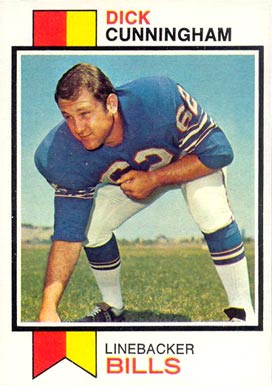
In 1973, Allen, Absher, and Cody were out, and ex-tight end Marlin McKeever and Dick Cunningham were in. McKeever made 11 starts in the middle, while Cunningham started 2 games. (I can't find my 1973 Dick Cunningham card, so my new Fred Whittingham 1966 custom card is filling in nicely!)
The Eagles finally put an end to their 4-year middle linebacker carousel by trading for Bill Bergey prior to the 1974 season. Bill solidified the middle for many seasons to come.
Frank Lemaster and John Bunting played on the wings, giving the Birds a nice linebacking corps, something they were missing since Maxie Baughan was traded after 1965.
(When Dick Vermeil arrived in 1976 he went to a 3-4 defense, with LeMaster moving inside next to Bergey.)
1969 Linebackers:
Middle: 52 - Dave Lloyd, 51 - Ike Kelley
Outside: 50 - Ron Porter, 35 - Adrian Young, 61 - Tony Guillory, 56 - Bill Hobbs, 48 - Jay Johnson
Dave Lloyd was the Birds' starting middle linebacker from 1963 until 5 games into the 1970 season, when he was replaced by Tim Rossovich.
Mike Morgan was the Eagles' starting left linebacker from 1964-67.
Harold Wells (no card) was the starting right linebacker from 1965-68.
Adrian Young was the Eagles' #3 draft pick in 1968, and played left linebacker from 1968-71, although missing most of 1971 due to injury. By the way, that's not Young's picture on his card. It's Eagles' 1968 punter Rick Duncan.
Ron Porter was acquired from the Colts in 1969, and was the starting right linebacker for 3 years, and the left-side starter during his 4th and last season with the Birds.
Tim Rossovich was the Eagles' #1 pick in 1968. After 2+ seasons as the starting left end, he moved to MLB after 5 games in 1970, and remained there through the 1971 season.
Steve Zabel was drafted as a tight end in 1970. He moved to linebacker in his 2nd season, and was a starter for his last 4 seasons in Philly - mostly on the left side but occasionally filling in at MLB.
***
After Rossovich didn't pan out following 1971, the Eagles brought in a host of middle linebackers in 1972. Ex-Charger and Steeler Chuck Allen started 8 games in '72, while Zabel started the other 6 games. (MLBs Dick Absher and Bill Cody worked on special teams.)
In 1973, Allen, Absher, and Cody were out, and ex-tight end Marlin McKeever and Dick Cunningham were in. McKeever made 11 starts in the middle, while Cunningham started 2 games. (I can't find my 1973 Dick Cunningham card, so my new Fred Whittingham 1966 custom card is filling in nicely!)
The Eagles finally put an end to their 4-year middle linebacker carousel by trading for Bill Bergey prior to the 1974 season. Bill solidified the middle for many seasons to come.
Frank Lemaster and John Bunting played on the wings, giving the Birds a nice linebacking corps, something they were missing since Maxie Baughan was traded after 1965.
(When Dick Vermeil arrived in 1976 he went to a 3-4 defense, with LeMaster moving inside next to Bergey.)
1969 Linebackers:
Middle: 52 - Dave Lloyd, 51 - Ike Kelley
Outside: 50 - Ron Porter, 35 - Adrian Young, 61 - Tony Guillory, 56 - Bill Hobbs, 48 - Jay Johnson
Saturday, May 13, 2017
Eagles who also played in the WFL
.
I was browsing the 'WFL Rosters' link at the bottom of the right sidebar on this blog, and found these Eagles who also played in the World Football League (1974-75).
The names in green were starters for the Eagles.
Players below the solid line near the end of the list were Eagles after their WFL days.
I was browsing the 'WFL Rosters' link at the bottom of the right sidebar on this blog, and found these Eagles who also played in the World Football League (1974-75).
The names in green were starters for the Eagles.
Players below the solid line near the end of the list were Eagles after their WFL days.
Labels:
...charts,
...WFL,
Adrian Young,
Ben Hawkins,
Cyril Pinder,
Dick Hart,
Ernie Calloway,
George Mira,
Gerry Philbin,
Joe Carollo,
John Huarte,
Lee Bouggess,
Mike Evans,
Ron Porter,
Tim Rossovich,
Vince Papale
Tuesday, May 9, 2017
The D-Line
Here are the Eagles' defensive lineman (mostly starters) who had football cards in the Topps or Philly Gum sets of the time.
Don Hultz played for the Eagles from 1964 to 1973. The starting left defensive end from '65-'67, he was replaced by #1 draft choice Tim Rossovich in 1968, but regained a starting spot (at LDT) when Rosso was moved to MLB midway through the 1970 season.
Floyd Peters was the starting LDT from 1964-69, except for missing 2/3 of 1968. He made 3 Pro Bowls during his time in Philly.
John Meyers was acquired from the Cowboys after the 1963 season, and started at right tackle from 1964-1967.
Rookie Gary Pettigrew replaced the veteran Bobby Richards at right end to start the 1966 season. After 2 years there, Pettigrew moved inside to RT, starting most of 1968-71 there. After a season on the bench, Gary was the starting left tackle in 1973, and was traded to the Giants after 4 games in 1974.
Mel Tom joined the Eagles as a linebacker in 1967 and was soon converted to a defensive end. He started all but 1 game at right end from 1968 to 1972. After 4 starts in 1973 he was dealt to the Bears.
Tim Rossovich was the Birds' top pick in 1968, and when he wasn't eating glass or setting his hair on fire, he played left end for 2-plus seasons. After 5 games in 1970, he was moved to MLB, replacing the veteran Dave Lloyd.
Ernie Calloway started 8 games at left tackle as a rookie in 1969. After 5 games there in '70, he moved to left end (replacing Rossovich) with Hultz returning to the starting lineup at tackle. In '71 he was a swingman – sharing left end with rookie Richard Harris and right tackle with Pettigrew. He started 5 games in 1972, and that was the end of his career. (I have a recollection that he was traded to the Chiefs, but the record doesn’t show any playing time there.)
Like they did 3 years earlier, the Eagles took a defensive end with their #1 pick in 1971. Richard Harris started 10 games at left end as a rookie and 13 more in his sophomore season. With Pettigrew and Calloway both gone by 1973, Harris started 10 games at right tackle, then played his remaining 4 seasons with the Bears and Seahawks.
Will Wynn was a 7th-round pick in 1973 and started 8 games at right end (replacing the departed Mel Tom). After 27 starts at left end from '74-'75, Wynn started every game on the right side in 1976. After the season, coach Dick Vermeil decided Wynn wasn't "his kind of player" and sent him packing.
Other short-term starters:
Randy Beisler (normally a guard) started 8 games at left D tackle in 1968, his 3rd and last season with the Eagles.
After 11 years with the Patriots, Houston Antwine finished his career with 1 season in Philly (1972), starting 9 games at right tackle as the Birds patched their D-line.
Long-time Jet Gerry Philbin shared the left end job with fellow import Dennis Wirgowski. It was Philbin's final season after 9 with the Jets.
After 3 seasons with the Patriots, Dennis Wirgowski finished his career with 8 starts for the Eagles in '73.
With Pettigrew and Harris leaving after 1973, there were no defensive lineman remaining from prior to 1973.
Joe Jones started 13 games at right end in his 1st season with the Eagles, and 5 more in 1975.
Defensive tackle Bill Dunstan started 7 games in ’73, 7 games in ’74, and 14 games in ’75.
Ex-Bill Jerry Patton started all 14 games at RDT in 1974, his only season in Philly.
Other Eagles’ draft picks Mitch Sutton (7) and Willie Cullars (1) made a few starts in 1974.
Rich Glover played 1 season (1975) with the Eagles, starting all 14 games at left tackle.
Blenda Gay started 8 games at right end in ’75, and ’13 games at left end in 1976. He was shot and killed in a domestic dispute just after the ’76 season.
The ’74 to ’75 Eagles was the era of ”The $400 Defensive Line” (what with waiver pickups costing $100).
Dick Vermeil began a major housecleaning along the D-line, bringing in Manny Sistrunk and Carl Hairston in 1976, and in 1977 switching to a 3-4, with rookie nose tackle Charlie Johnson joining the team.
.
(Rossovich also started 25 games at MLB from 1971 to 1972.)
1969 Defensive linemen:
Ends: 82 - Tim Rossovich, 58 - Mel Tom, 83 - Don Hultz
Tackles: 72 - Floyd Peters, 88 - Gary Pettigrew, 57 - Ernie Calloway, 62 - Mike Dirks
Don Hultz played for the Eagles from 1964 to 1973. The starting left defensive end from '65-'67, he was replaced by #1 draft choice Tim Rossovich in 1968, but regained a starting spot (at LDT) when Rosso was moved to MLB midway through the 1970 season.
Floyd Peters was the starting LDT from 1964-69, except for missing 2/3 of 1968. He made 3 Pro Bowls during his time in Philly.
John Meyers was acquired from the Cowboys after the 1963 season, and started at right tackle from 1964-1967.
Rookie Gary Pettigrew replaced the veteran Bobby Richards at right end to start the 1966 season. After 2 years there, Pettigrew moved inside to RT, starting most of 1968-71 there. After a season on the bench, Gary was the starting left tackle in 1973, and was traded to the Giants after 4 games in 1974.
Mel Tom joined the Eagles as a linebacker in 1967 and was soon converted to a defensive end. He started all but 1 game at right end from 1968 to 1972. After 4 starts in 1973 he was dealt to the Bears.
Tim Rossovich was the Birds' top pick in 1968, and when he wasn't eating glass or setting his hair on fire, he played left end for 2-plus seasons. After 5 games in 1970, he was moved to MLB, replacing the veteran Dave Lloyd.
Ernie Calloway started 8 games at left tackle as a rookie in 1969. After 5 games there in '70, he moved to left end (replacing Rossovich) with Hultz returning to the starting lineup at tackle. In '71 he was a swingman – sharing left end with rookie Richard Harris and right tackle with Pettigrew. He started 5 games in 1972, and that was the end of his career. (I have a recollection that he was traded to the Chiefs, but the record doesn’t show any playing time there.)
Like they did 3 years earlier, the Eagles took a defensive end with their #1 pick in 1971. Richard Harris started 10 games at left end as a rookie and 13 more in his sophomore season. With Pettigrew and Calloway both gone by 1973, Harris started 10 games at right tackle, then played his remaining 4 seasons with the Bears and Seahawks.
Will Wynn was a 7th-round pick in 1973 and started 8 games at right end (replacing the departed Mel Tom). After 27 starts at left end from '74-'75, Wynn started every game on the right side in 1976. After the season, coach Dick Vermeil decided Wynn wasn't "his kind of player" and sent him packing.
Other short-term starters:
Randy Beisler (normally a guard) started 8 games at left D tackle in 1968, his 3rd and last season with the Eagles.
After 11 years with the Patriots, Houston Antwine finished his career with 1 season in Philly (1972), starting 9 games at right tackle as the Birds patched their D-line.
Long-time Jet Gerry Philbin shared the left end job with fellow import Dennis Wirgowski. It was Philbin's final season after 9 with the Jets.
After 3 seasons with the Patriots, Dennis Wirgowski finished his career with 8 starts for the Eagles in '73.
With Pettigrew and Harris leaving after 1973, there were no defensive lineman remaining from prior to 1973.
Joe Jones started 13 games at right end in his 1st season with the Eagles, and 5 more in 1975.
Defensive tackle Bill Dunstan started 7 games in ’73, 7 games in ’74, and 14 games in ’75.
Ex-Bill Jerry Patton started all 14 games at RDT in 1974, his only season in Philly.
Other Eagles’ draft picks Mitch Sutton (7) and Willie Cullars (1) made a few starts in 1974.
Rich Glover played 1 season (1975) with the Eagles, starting all 14 games at left tackle.
Blenda Gay started 8 games at right end in ’75, and ’13 games at left end in 1976. He was shot and killed in a domestic dispute just after the ’76 season.
The ’74 to ’75 Eagles was the era of ”The $400 Defensive Line” (what with waiver pickups costing $100).
Dick Vermeil began a major housecleaning along the D-line, bringing in Manny Sistrunk and Carl Hairston in 1976, and in 1977 switching to a 3-4, with rookie nose tackle Charlie Johnson joining the team.
.
(Rossovich also started 25 games at MLB from 1971 to 1972.)
1969 Defensive linemen:
Ends: 82 - Tim Rossovich, 58 - Mel Tom, 83 - Don Hultz
Tackles: 72 - Floyd Peters, 88 - Gary Pettigrew, 57 - Ernie Calloway, 62 - Mike Dirks
Monday, January 23, 2017
The O-Line
The Eagles had a lot of offensive linemen pass through their roster from 1966 to 1975, but this post will focus on the starters, and not the many fringe players. (In some years, the fringe players WERE the starters!)
The 1960s:
Lane Howell was acquired from the Giants prior to the 1965 season, and started at left tackle from 1965-69. This is a custom card from RetroCards (thecowboysguide.com).
Ed Blaine began with the Packers in 1962, and was the Eagles' left guard from 1963-66, before retiring to pursue a medical career.
Dick Hart was the Eagles' starting left guard from 1967-70. Hart grew up in the Philadelphia suburbs, and was a member of the 1955 Little League World Series champions. After playing minor-league baseball for the Braves from 1961-65, he signed as a walk-on with the Eagles in 1967 (having played no football since high school). A knee injury ended his career before the 1971 season.
Hall-of-Famer Jim Ringo made 7 Pro Bowls in his 11 seasons with the Packers, then finished his career as the Eagles' starting center from 1964-67, making the Pro Bowl 3 more times with Philly.
Jim Skaggs played for the Eagles from 1963-72, and was the starting right guard every year from 1965-70, except for missing 1968 with injuries. This is a custom card from RetroCards (thecowboysguide.com).
Bob Brown was the Eagles' starting right tackle from 1964-68. He made 3 Pro Bowls with the Birds, and another 2 after he was traded to the Rams. (When ex-Eagles' tight end Pete Retzlaff was named the GM in 1969, Brown immediately demanded a trade, going to LA in exchange for receiver Harold Jackson.)
Dave Graham was the starting left tackle in '63 and '64, and stuck around as a backup through the 1969 season.
The O-line turned over at the start of the 1970s:
Wade Key played for the Eagles from 1970-79. He was the starting left tackle from 70-72, then moved to guard when Jerry Sisemore was drafted. He was the starting left guard from 1973-79, except for missing the '75 season with injuries. After laboring for 10 seasons with mostly bad teams, unfortunately Key was cut in training camp in 1980 - the year they finally went to the Super Bowl.
Henry Allison played for the Eagles from 1971-72. With Hart sidelined by injuries, Allison was the starting left guard for one season (1971).
Tom Luken was the Eagles' #2 pick in 1972. He played for the team from 1972-78, but was only a starter in his rookie season, sent to the bench with Key’s move from tackle to guard.
After Ringo’s retirement following the 1967 season, the Eagles signed 2 centers – Gene Ceppetelli and Mike Evans. Ceppetelli was the starter in '68, and Evans from 1969-72.
Mark Nordquist played for the Eagles from 1968-74. After filling in for the injured Skaggs in 1968, Mark was the starting right guard from 1971-74. He was also the backup center.
Joe Carollo was acquired from the Rams in the Bob Brown trade prior to 1969, and started at right tackle for 2 seasons before returning to the Rams.
Steve Smith was acquired from the Vikings in 1971 for QB Norm Snead. He played right tackle from 1971-72, then moved to the left side to accommodate Sisemore in 1973. Also the starter in 1974, he was eventually replaced by Stan Walters.
The mid-1970s:
Stan Walters was acquired from the Bengals (1 year after the Eagles acquired MLB Bill Bergey from the Bengals) and was an upgrade to the QB's blindside protection. He played for the Eagles from 1975-83, making 2 Pro Bowls during that time.
After 9 seasons (and 6 Pro Bowls) with the Cowboys, John Niland played his last season as the Eagles' starting left guard in 1975, filling in for the injured Wade Key.
Guy Morris was the Eagles' #2 pick in 1973. A guard in college, he was converted to center as a rookie. He was the team’s starting center for his 11 years with the team (1973-83).
After 7 seasons as the Packers' left guard, Bill Lueck played his final season for the Eagles in 1975, replacing the traded Mark Nordquist at right guard.
Jerry Sisemore was one of the Birds’ two #1 picks in the 1973 draft. He was a starting lineman for 11 seasons from 1973-83, all at right tackle except for '76-'77 at right guard.
1969 Offensive linemen:
Centers: 59 - Mike Evans, 54 - Gene Ceppetelli
Guards: 70 - Jim Skaggs, 71 - Dick Hart, 68 - Mark Nordquist, 66 - Don Chuy
Tackles: 79 - Lane Howell, 76 - Joe Carollo, 78 - Dave Graham, 55 - Wade Key
The 1960s:
Lane Howell was acquired from the Giants prior to the 1965 season, and started at left tackle from 1965-69. This is a custom card from RetroCards (thecowboysguide.com).
Ed Blaine began with the Packers in 1962, and was the Eagles' left guard from 1963-66, before retiring to pursue a medical career.
Dick Hart was the Eagles' starting left guard from 1967-70. Hart grew up in the Philadelphia suburbs, and was a member of the 1955 Little League World Series champions. After playing minor-league baseball for the Braves from 1961-65, he signed as a walk-on with the Eagles in 1967 (having played no football since high school). A knee injury ended his career before the 1971 season.
Hall-of-Famer Jim Ringo made 7 Pro Bowls in his 11 seasons with the Packers, then finished his career as the Eagles' starting center from 1964-67, making the Pro Bowl 3 more times with Philly.
Jim Skaggs played for the Eagles from 1963-72, and was the starting right guard every year from 1965-70, except for missing 1968 with injuries. This is a custom card from RetroCards (thecowboysguide.com).
Bob Brown was the Eagles' starting right tackle from 1964-68. He made 3 Pro Bowls with the Birds, and another 2 after he was traded to the Rams. (When ex-Eagles' tight end Pete Retzlaff was named the GM in 1969, Brown immediately demanded a trade, going to LA in exchange for receiver Harold Jackson.)
Dave Graham was the starting left tackle in '63 and '64, and stuck around as a backup through the 1969 season.
The O-line turned over at the start of the 1970s:
Wade Key played for the Eagles from 1970-79. He was the starting left tackle from 70-72, then moved to guard when Jerry Sisemore was drafted. He was the starting left guard from 1973-79, except for missing the '75 season with injuries. After laboring for 10 seasons with mostly bad teams, unfortunately Key was cut in training camp in 1980 - the year they finally went to the Super Bowl.
Henry Allison played for the Eagles from 1971-72. With Hart sidelined by injuries, Allison was the starting left guard for one season (1971).
Tom Luken was the Eagles' #2 pick in 1972. He played for the team from 1972-78, but was only a starter in his rookie season, sent to the bench with Key’s move from tackle to guard.
After Ringo’s retirement following the 1967 season, the Eagles signed 2 centers – Gene Ceppetelli and Mike Evans. Ceppetelli was the starter in '68, and Evans from 1969-72.
Mark Nordquist played for the Eagles from 1968-74. After filling in for the injured Skaggs in 1968, Mark was the starting right guard from 1971-74. He was also the backup center.
Joe Carollo was acquired from the Rams in the Bob Brown trade prior to 1969, and started at right tackle for 2 seasons before returning to the Rams.
Steve Smith was acquired from the Vikings in 1971 for QB Norm Snead. He played right tackle from 1971-72, then moved to the left side to accommodate Sisemore in 1973. Also the starter in 1974, he was eventually replaced by Stan Walters.
The mid-1970s:
Stan Walters was acquired from the Bengals (1 year after the Eagles acquired MLB Bill Bergey from the Bengals) and was an upgrade to the QB's blindside protection. He played for the Eagles from 1975-83, making 2 Pro Bowls during that time.
After 9 seasons (and 6 Pro Bowls) with the Cowboys, John Niland played his last season as the Eagles' starting left guard in 1975, filling in for the injured Wade Key.
Guy Morris was the Eagles' #2 pick in 1973. A guard in college, he was converted to center as a rookie. He was the team’s starting center for his 11 years with the team (1973-83).
After 7 seasons as the Packers' left guard, Bill Lueck played his final season for the Eagles in 1975, replacing the traded Mark Nordquist at right guard.
Jerry Sisemore was one of the Birds’ two #1 picks in the 1973 draft. He was a starting lineman for 11 seasons from 1973-83, all at right tackle except for '76-'77 at right guard.
1969 Offensive linemen:
Centers: 59 - Mike Evans, 54 - Gene Ceppetelli
Guards: 70 - Jim Skaggs, 71 - Dick Hart, 68 - Mark Nordquist, 66 - Don Chuy
Tackles: 79 - Lane Howell, 76 - Joe Carollo, 78 - Dave Graham, 55 - Wade Key
Tuesday, December 27, 2016
The Receivers
Here are the Eagles’ top receivers from 1966-75. Unless otherwise mentioned in the text below, all the other significant pass catchers were running backs.
The Eagles starting receivers in 1966 were Pete Retzlaff (TE), Fred Hill (SE) and Ron Goodwin (FL). Retzlaff’s entire career (1956-66) was as a starter for the Eagles, first as a split end before moving to tight end in 1963. Hill played his entire career (1965-71) with the Eagles, and in 1966 filled in at SE for Ray Poage, the Eagles split end in ’64 and ’65 who missed the ’66 season with a knee injury. Goodwin also played his entire career (1963-68) with the Eagles, and was their starting flanker from 1963-66. Rookie Ben Hawkins was the #4 receiver, almost equaling Goodwin’s catches.
A new group of receivers took over in 1967. Hawkins led the team in receptions from his flanker spot, and was joined by newly-acquired veterans Gary Ballman (SE) and Mike Ditka (TE). Hawkins played for the Eagles from 1966-74, and was a starting wideout every season except his first and last. He led the NFL in receiving yards in 1967. Ballman played for the Eagles from 1967-72, and was a starter every season but his last. After 2 years as a split end, he moved to TE in 1969. Ditka sandwiched his 2 seasons with the Eagles (’67-’68) between stints with the Bears and Cowboys. He was the starting TE in ’67 (although missing 5 games), but was 2nd-team in 1968.
Fred Hill replaced Ditka at tight end in 1968, joining Hawkins and Ballman in the starting lineup.
In 1969, Harold Jackson joined the Eagles (acquired from the Rams in the Bob Brown trade) and immediately became their best player. Jackson played 4 seasons with the Eagles before returning to the Rams in the Roman Gabriel trade. He led the NFL in receiving yards in ’69 and ’72. With the addition of Jackson, Ballman moved to tight end.
All 3 starters (Jackson, Hawkins, Ballman) returned for 1970, although curiously, Ballman led the team in receptions.
With Ballman injured for much of 1971, rookie Harold Carmichael joined the starting group, as the tight end. Carmichael played for the Eagles from 1971-83, and was a starting WR in all but his first 2 seasons.
Jackson, Hawkins, and Carmichael were the top 3 receivers in 1972, although Carmichael split his time between TE and WR. Kent Kramer (an Eagle from 1971-74) was the nominal #1 tight end, although a distant 6th in receptions.
After leading the NFL in receptions and receiving yards in 1972, Jackson was traded back to the Rams. No big loss – Carmichael stepped in as the Eagles’ #1 wide receiver and led the NFL in receiving yards in 1973.
He was joined by #1 draft pick Charlie Young at TE and rookie Don Zimmerman at WR. Young was the Birds’ starting tight end for his first 4 seasons, then was traded to the Rams (see a pattern?) for QB Ron Jaworski. Replacing Hawkins in the lineup, Zimmerman was a serviceable starter for 2 seasons, and a backup for 2 more.
The Eagles used the same 3 receivers in 1974, then 2nd-year man Charlie Smith replaced Zimmerman as the #2 wide receiver in 1975. Smith was a starter from 1975-81.
1969 Receivers:
WR: 29 - Harold Jackson, 18 - Ben Hawkins, 13 - Chuck Hughes, 12 - Kent Lawrence
TE: 85 - Gary Ballman, 86 - Fred Hill, 87 - Fred Brown
The Eagles starting receivers in 1966 were Pete Retzlaff (TE), Fred Hill (SE) and Ron Goodwin (FL). Retzlaff’s entire career (1956-66) was as a starter for the Eagles, first as a split end before moving to tight end in 1963. Hill played his entire career (1965-71) with the Eagles, and in 1966 filled in at SE for Ray Poage, the Eagles split end in ’64 and ’65 who missed the ’66 season with a knee injury. Goodwin also played his entire career (1963-68) with the Eagles, and was their starting flanker from 1963-66. Rookie Ben Hawkins was the #4 receiver, almost equaling Goodwin’s catches.
A new group of receivers took over in 1967. Hawkins led the team in receptions from his flanker spot, and was joined by newly-acquired veterans Gary Ballman (SE) and Mike Ditka (TE). Hawkins played for the Eagles from 1966-74, and was a starting wideout every season except his first and last. He led the NFL in receiving yards in 1967. Ballman played for the Eagles from 1967-72, and was a starter every season but his last. After 2 years as a split end, he moved to TE in 1969. Ditka sandwiched his 2 seasons with the Eagles (’67-’68) between stints with the Bears and Cowboys. He was the starting TE in ’67 (although missing 5 games), but was 2nd-team in 1968.
Fred Hill replaced Ditka at tight end in 1968, joining Hawkins and Ballman in the starting lineup.
In 1969, Harold Jackson joined the Eagles (acquired from the Rams in the Bob Brown trade) and immediately became their best player. Jackson played 4 seasons with the Eagles before returning to the Rams in the Roman Gabriel trade. He led the NFL in receiving yards in ’69 and ’72. With the addition of Jackson, Ballman moved to tight end.
All 3 starters (Jackson, Hawkins, Ballman) returned for 1970, although curiously, Ballman led the team in receptions.
With Ballman injured for much of 1971, rookie Harold Carmichael joined the starting group, as the tight end. Carmichael played for the Eagles from 1971-83, and was a starting WR in all but his first 2 seasons.
Jackson, Hawkins, and Carmichael were the top 3 receivers in 1972, although Carmichael split his time between TE and WR. Kent Kramer (an Eagle from 1971-74) was the nominal #1 tight end, although a distant 6th in receptions.
After leading the NFL in receptions and receiving yards in 1972, Jackson was traded back to the Rams. No big loss – Carmichael stepped in as the Eagles’ #1 wide receiver and led the NFL in receiving yards in 1973.
He was joined by #1 draft pick Charlie Young at TE and rookie Don Zimmerman at WR. Young was the Birds’ starting tight end for his first 4 seasons, then was traded to the Rams (see a pattern?) for QB Ron Jaworski. Replacing Hawkins in the lineup, Zimmerman was a serviceable starter for 2 seasons, and a backup for 2 more.
The Eagles used the same 3 receivers in 1974, then 2nd-year man Charlie Smith replaced Zimmerman as the #2 wide receiver in 1975. Smith was a starter from 1975-81.
1969 Receivers:
WR: 29 - Harold Jackson, 18 - Ben Hawkins, 13 - Chuck Hughes, 12 - Kent LawrenceTE: 85 - Gary Ballman, 86 - Fred Hill, 87 - Fred Brown
Friday, December 9, 2016
The Running Backs
Here are the Eagles' 12 primary running backs from 1966 to 1975. There were quite a few others (such as 1967 #1 draft pick/bust Harry Jones), but these below are all the starters.
We start off with the tandem of Timmy Brown and Earl Gros. Brown played for the Eagles from 1960-67, and was their starting halfback from '62 to '66. Gros was the starting fullback for his 3 seasons with the Eagles (1964-66).
After backing up Brown and Gros in 1966, Izzy Lang and Tom Woodeshick took over as the starting backfield for '67 and '68. Woodeshick led the team in rushing from 1967 to 1969.
Leroy Keyes was the Eagles' #1 pick in 1969. [After an 0-12 start, the Birds won their last 2 games, thus blowing the chance to draft O.J. Simpson.] After a serviceable rookie season, Keyes had an awful 2nd year, then was moved to strong safety for his final 2 seasons with the Eagles. Leroy was 2nd in rushing behind Woodeshick in 1969.
After 2 seasons as the #3 back, Cyril Pinder led the Eagles in rushing in 1970, teaming with rookie fullback Lee Bouggess. Woodeshick and rookie Larry Watkins rounded out the top 4.
Pinder was traded away after the 1970 season, leaving Bouggess as the team's top rusher in 1971. He was joined by halfback Ron Bull, who played his final season with the Eagles after playing for the Bears from 1962-70. As in 1970, Woodeshick and Watkins were the 3rd and 4th backs.
With Bouggess lost for the season due to injury, Bull retired, and Woodeshick traded, the Eagles featured a new set of backs in 1972. Rookie Ron "Po" James led the team in rushing, with Larry Watkins sharing the fullback job with ex-Saint Tony Baker.
James' time at the top was short, with rookie Tom Sullivan taking over the starting halfback job for the next 3 seasons. Sullivan would lead the team in rushing from 1973-75. Norm Bulaich joined the team in 1973, and was the starting fullback for his 2 seasons in Philly ('73-'74). James was the #3 back for the '73 and '74 seasons.
In 1975, Sullivan had a new running mate: Art Malone was brought in from Atlanta as the fullback. Rookie James McAlister was #3 with Po James at #4.
--
When Dick Vermeil was hired for the 1976 season, he cleaned house at several positions, including running back. The only holdovers from 1975 were Sullivan and McAllister. Rookies Mike Hogan and Herb Lusk were in the mix, plus newly-acquired veterans Dave Hampton and Bill Olds.
1969 Running backs:
37 - Tom Woodeshick, 20 - Leroy Keyes, 22 - Cyril Pinder, 33 - Ronny Blye, 23 - Harry Jones
We start off with the tandem of Timmy Brown and Earl Gros. Brown played for the Eagles from 1960-67, and was their starting halfback from '62 to '66. Gros was the starting fullback for his 3 seasons with the Eagles (1964-66).
After backing up Brown and Gros in 1966, Izzy Lang and Tom Woodeshick took over as the starting backfield for '67 and '68. Woodeshick led the team in rushing from 1967 to 1969.
Leroy Keyes was the Eagles' #1 pick in 1969. [After an 0-12 start, the Birds won their last 2 games, thus blowing the chance to draft O.J. Simpson.] After a serviceable rookie season, Keyes had an awful 2nd year, then was moved to strong safety for his final 2 seasons with the Eagles. Leroy was 2nd in rushing behind Woodeshick in 1969.
After 2 seasons as the #3 back, Cyril Pinder led the Eagles in rushing in 1970, teaming with rookie fullback Lee Bouggess. Woodeshick and rookie Larry Watkins rounded out the top 4.
Pinder was traded away after the 1970 season, leaving Bouggess as the team's top rusher in 1971. He was joined by halfback Ron Bull, who played his final season with the Eagles after playing for the Bears from 1962-70. As in 1970, Woodeshick and Watkins were the 3rd and 4th backs.
With Bouggess lost for the season due to injury, Bull retired, and Woodeshick traded, the Eagles featured a new set of backs in 1972. Rookie Ron "Po" James led the team in rushing, with Larry Watkins sharing the fullback job with ex-Saint Tony Baker.
James' time at the top was short, with rookie Tom Sullivan taking over the starting halfback job for the next 3 seasons. Sullivan would lead the team in rushing from 1973-75. Norm Bulaich joined the team in 1973, and was the starting fullback for his 2 seasons in Philly ('73-'74). James was the #3 back for the '73 and '74 seasons.
In 1975, Sullivan had a new running mate: Art Malone was brought in from Atlanta as the fullback. Rookie James McAlister was #3 with Po James at #4.
--
When Dick Vermeil was hired for the 1976 season, he cleaned house at several positions, including running back. The only holdovers from 1975 were Sullivan and McAllister. Rookies Mike Hogan and Herb Lusk were in the mix, plus newly-acquired veterans Dave Hampton and Bill Olds.
1969 Running backs:
37 - Tom Woodeshick, 20 - Leroy Keyes, 22 - Cyril Pinder, 33 - Ronny Blye, 23 - Harry Jones
Friday, November 25, 2016
Team Photo - 1969
1969 PHILADELPHIA EAGLES
Here is the 1969 squad, the final season for these jerseys with the double-stripes around the shoulders. There are 47 players in the photo. If I recall correctly, back then teams had 40 active players, plus a 7-man taxi squad. Starters are shown with positions below in uppercase.
Back row: Sam Baker (k-p), Lane Howell (T), Norm Snead (QB), Don Hultz (de), Mel Tom (DE), Fred Brown (te), Dave Lloyd (MLB), Gary Pettigrew (dt), Mark Nordquist (g), Mike Evans ( C), Ronnie Blye (rb), Cyril Pinder (rb), coach, coach.
Row 3: Joe Moss (coach), Charlie Gauer (coach), Chuck Sieminski (dt), Jay Johnson (lb), Dave Graham (t), Joe Carollo (T), Mike Dirks (dt), Gary Ballman (TE) Jim Skaggs (G), Wade Key (t), Ron Porter (LB), Ernie Calloway (DT), Tony Guillory (LB), Bill Bradley (s), Moose Detty (trainer), Dick Stanfel (coach).
Row 2: Bob Colonna (equip mgr), Leroy Keyes (RB), Nate Ramsey (SS), Ron Medved (s), Ben Hawkins (WR), Fred Hill (te), Floyd Peters (DT), Jerry Williams (head coach), Tom Woodeshick (RB), Adrian Young (lb), Tim Rossovich (DE), Don Chuy (g), Gene Ceppetelli (c ), Dick Hart (G), Vince Fazio (team doctor).
Front row: Irv Cross (CB), George Mira (qb), Joe Scarpati (FS), Gary Adams (db), Harold Jackson (WR), Chuck Hughes (wr), Kent Lawrence (wr), Ike Kelley (mlb), Harry Jones (rb), Bill Hobbs (lb), Al Nelson (CB).
Chuck Sieminski and Gary Adams did not make the team.
Wade Key spent the season on the taxi squad.
Notice the early-career jersey numbers for Mel Tom (58), Wade Key (55), and Ernie Calloway (57).
Here is the 1969 squad, the final season for these jerseys with the double-stripes around the shoulders. There are 47 players in the photo. If I recall correctly, back then teams had 40 active players, plus a 7-man taxi squad. Starters are shown with positions below in uppercase.
Back row: Sam Baker (k-p), Lane Howell (T), Norm Snead (QB), Don Hultz (de), Mel Tom (DE), Fred Brown (te), Dave Lloyd (MLB), Gary Pettigrew (dt), Mark Nordquist (g), Mike Evans ( C), Ronnie Blye (rb), Cyril Pinder (rb), coach, coach.
Row 3: Joe Moss (coach), Charlie Gauer (coach), Chuck Sieminski (dt), Jay Johnson (lb), Dave Graham (t), Joe Carollo (T), Mike Dirks (dt), Gary Ballman (TE) Jim Skaggs (G), Wade Key (t), Ron Porter (LB), Ernie Calloway (DT), Tony Guillory (LB), Bill Bradley (s), Moose Detty (trainer), Dick Stanfel (coach).
Row 2: Bob Colonna (equip mgr), Leroy Keyes (RB), Nate Ramsey (SS), Ron Medved (s), Ben Hawkins (WR), Fred Hill (te), Floyd Peters (DT), Jerry Williams (head coach), Tom Woodeshick (RB), Adrian Young (lb), Tim Rossovich (DE), Don Chuy (g), Gene Ceppetelli (c ), Dick Hart (G), Vince Fazio (team doctor).
Front row: Irv Cross (CB), George Mira (qb), Joe Scarpati (FS), Gary Adams (db), Harold Jackson (WR), Chuck Hughes (wr), Kent Lawrence (wr), Ike Kelley (mlb), Harry Jones (rb), Bill Hobbs (lb), Al Nelson (CB).
Chuck Sieminski and Gary Adams did not make the team.
Wade Key spent the season on the taxi squad.
Notice the early-career jersey numbers for Mel Tom (58), Wade Key (55), and Ernie Calloway (57).
Monday, November 21, 2016
The Kickers and Punters
This is the 2nd post in a series where I will review the 1966-75 Eagles by position. Normally I won't be listing every player during this time span, but there aren't that many kickers, so here they are.
KICKERS:
#38 Sam Baker - Baker joined the Eagles (from the Cowboys!) in 1964, and was their placekicker for the rest of the 1960s. He was also the punter through the 1968 season.
#3 Mark Moseley - The "Last of the Straight-on Kickers" was a 14th-round pick in 1970. He kicked only one year for the Eagles, partly because after the punter was lost for the season with injuries, Mark doubled up on the punting as well, and it messed him up. Regrettably, the Eagles lost patience after just 1 season, and Moseley was sent packing. He later went on to a long career with the Redskins from 1974-86.
#52 Dave Lloyd - I recall that after long-time middle linebacker Dave Lloyd lost his job to converted defensive end Tim Rossovich midway through the 1970 season, Lloyd kept himself busy for the rest of the year by kicking off (no FG or XP), thus lightening Moseley's load (after Mark was called upon to be the replacement punter).
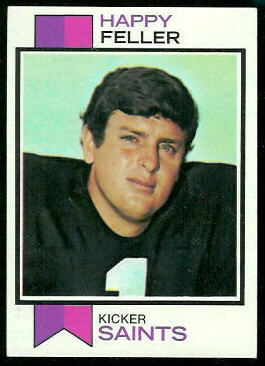
#1 Happy Feller - The Eagles burned a 4th-round draft pick on Happy Feller in 1971. His stay was shorter than Moseley's. By mid-season the Eagles signed Tom Dempsey, and activated him for the final 5 games, replacing Feller. (I have his 1973 card as shown in the link, but can't find my 1973 binder right now.)
#19 Tom Dempsey - Dempsey previously kicked for the Saints, including a record 63-yard field goal in 1970. In a classic "What have you done for me lately?" move, the Saints cut him before the following season. The Birds picked him up during 1971, and he played the final 5 games in 1971 and every game through the end of 1974.
#16 Horst Muhlmann - The former Bengals kicker played for the Eagles for 2 1/2 seasons, beginning in 1975.
PUNTERS:
#10 King Hill - Hill joined the Eagles in 1961, and in addition to being the #2 QB through 1968, he was also the team's punter through the 1963 season. With the arrival of Sam Baker in 1964, they shared the punting chores for 3 seasons, roughly 65/35 in favor of Baker.
#38 Sam Baker - Baker shared the punting chores with Hill from 1964-66, and was the only punter from 1967-68. He relinquished the punting to rookie Bill Bradley in 1969.
#32 Rick Duncan - Duncan (pictured here on Adrian Young's 1971 card) punted in 1 game in 1968. He was also in Eagles' camp in 1971, but did not make the team.
#28 Bill Bradley - "Super Bill" was the team's free safety and punt returner from 1969-75. He was also the punter in '69, '70, '72, and for 4 games in '73.
#36, #12 Tom McNeill - McNeill was the team's punter in '71 and '73, and for 2 games in 1972. (In summary, Bradley and/or McNeill handled the punting from 1969-73, with some punting by Moseley late in 1970.)
#37 Merritt Kersey - Kersey assumed the punting job for 1974 and 2 games in 1975. It was his only NFL experience.
#6 Spike Jones - Jones took over the punting in game #3 in 1975, and stuck around through the 1977 season.
1969 Kickers:
38 - Sam Baker (K), 28 - Bill Bradley (S/P)
KICKERS:
#38 Sam Baker - Baker joined the Eagles (from the Cowboys!) in 1964, and was their placekicker for the rest of the 1960s. He was also the punter through the 1968 season.
#3 Mark Moseley - The "Last of the Straight-on Kickers" was a 14th-round pick in 1970. He kicked only one year for the Eagles, partly because after the punter was lost for the season with injuries, Mark doubled up on the punting as well, and it messed him up. Regrettably, the Eagles lost patience after just 1 season, and Moseley was sent packing. He later went on to a long career with the Redskins from 1974-86.
#52 Dave Lloyd - I recall that after long-time middle linebacker Dave Lloyd lost his job to converted defensive end Tim Rossovich midway through the 1970 season, Lloyd kept himself busy for the rest of the year by kicking off (no FG or XP), thus lightening Moseley's load (after Mark was called upon to be the replacement punter).
#1 Happy Feller - The Eagles burned a 4th-round draft pick on Happy Feller in 1971. His stay was shorter than Moseley's. By mid-season the Eagles signed Tom Dempsey, and activated him for the final 5 games, replacing Feller. (I have his 1973 card as shown in the link, but can't find my 1973 binder right now.)
#19 Tom Dempsey - Dempsey previously kicked for the Saints, including a record 63-yard field goal in 1970. In a classic "What have you done for me lately?" move, the Saints cut him before the following season. The Birds picked him up during 1971, and he played the final 5 games in 1971 and every game through the end of 1974.
#16 Horst Muhlmann - The former Bengals kicker played for the Eagles for 2 1/2 seasons, beginning in 1975.
PUNTERS:
#10 King Hill - Hill joined the Eagles in 1961, and in addition to being the #2 QB through 1968, he was also the team's punter through the 1963 season. With the arrival of Sam Baker in 1964, they shared the punting chores for 3 seasons, roughly 65/35 in favor of Baker.
#38 Sam Baker - Baker shared the punting chores with Hill from 1964-66, and was the only punter from 1967-68. He relinquished the punting to rookie Bill Bradley in 1969.
#32 Rick Duncan - Duncan (pictured here on Adrian Young's 1971 card) punted in 1 game in 1968. He was also in Eagles' camp in 1971, but did not make the team.
#28 Bill Bradley - "Super Bill" was the team's free safety and punt returner from 1969-75. He was also the punter in '69, '70, '72, and for 4 games in '73.
#36, #12 Tom McNeill - McNeill was the team's punter in '71 and '73, and for 2 games in 1972. (In summary, Bradley and/or McNeill handled the punting from 1969-73, with some punting by Moseley late in 1970.)
#37 Merritt Kersey - Kersey assumed the punting job for 1974 and 2 games in 1975. It was his only NFL experience.
#6 Spike Jones - Jones took over the punting in game #3 in 1975, and stuck around through the 1977 season.
1969 Kickers:
38 - Sam Baker (K), 28 - Bill Bradley (S/P)
Subscribe to:
Posts (Atom)